

How To Set A Goal On Lyft
Lyft combats climate change with every ride
Funding emission reduction projects and catalyzing change in transportation

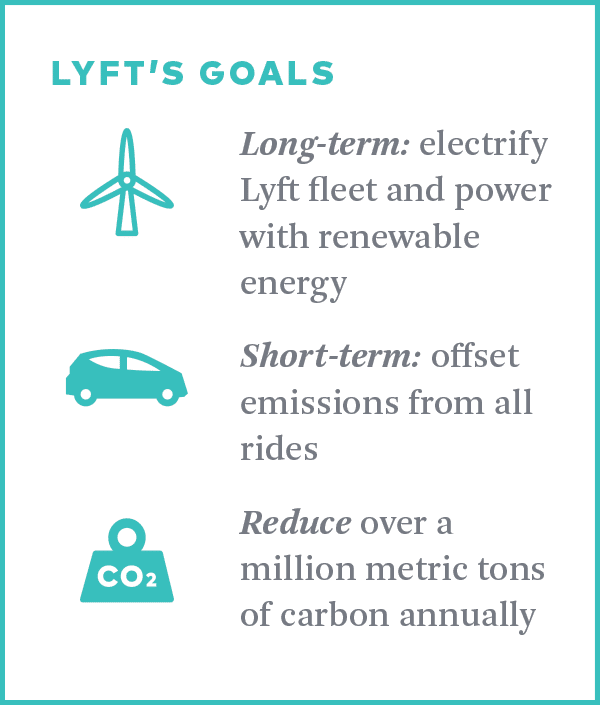 Lyft, the global ride-hailing service, cares securely about their impact on the environment and the communities they serve. In 2022, Lyft announced their 2025 climate impact goals, which include moving to autonomous electrical vehicles powered by renewable free energy and reducing overall CO2 emissions in the transportation sector. Every bit part of delivering on their Green Cities Initiative in support of these goals, Lyft partnered with 3Degrees to look for both near-term and longer-term opportunities to reduce their environmental impact.
Key challenges
Emissions from the transportation sector are a stubborn problem. Petroleum-based fuels like gasoline are deeply embedded in our vehicle and fuel distribution infrastructure, resulting in large quantities of carbon dioxide and other tailpipe emissions. Lyft'southward long-term vision for addressing this is an all-electrical vehicle armada powered by 100% renewable electricity – an ambitious goal that will have time to accomplish. In the short-term, Lyft sought to take immediate steps to address its environmental bear on in a relevant and meaningful style.
Lyft set an ambitious goal – to get-go emissions from all Lyft rides worldwide.
Lyft set an ambitious goal – to outset emissions from all Lyft rides worldwide. In its initial engagement, Lyft wanted to be intentional nearly the projects in which they supported, placing a high priority on projects in the transportation sector, near their major markets or in another style relevant to Lyft'south business.
How we helped
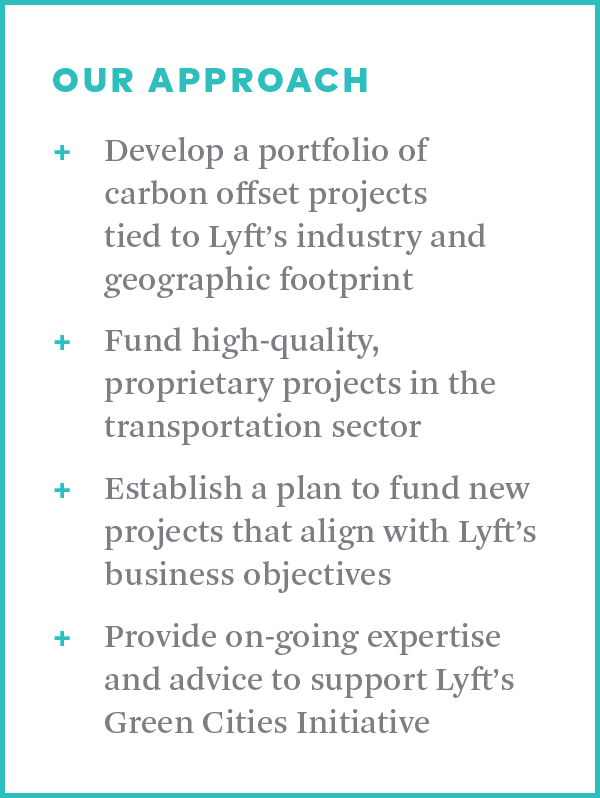
In collaboration with Lyft's sustainability squad, 3Degrees designed a program that would run into the to a higher place goals and accept the flexibility to evolve and grow with Lyft's business concern. Lyft'due south initial investment used carbon offsets as a tool to fund emission reduction projects that event in tangible changes in the mode parts of the transportation sector operate. The program as well supported projects that assist address other ecology impacts from vehicle use, such as water and not-GHG air pollutants.
The key elements of the Lyft program designed by 3Degrees are:
- Environmental integrity was the nearly important aspect of the program design and a core element of every carbon offset sold by 3Degrees. Environmental integrity can more often than not be broken down into two primary components: (a) "additionality," the notion that the emission reductions would non accept been achieved without the funding from carbon offset sales, and (b) rigorous and conservative quantification of the actual emission reductions achieved. All 3Degrees projects are registered under internationally recognized standards maintained by not-for-profit environmental organizations, including the American Carbon Registry (ACR), Climate Activeness Reserve (CAR), and Verified Carbon Standard (VCS). These standards require that projection emission reductions are monitored and quantified on a regular ground and that this quantification and project additionality are independently verified by accredited third parties.
- Reductions in transportation sector emissions played a major role in the project portfolio. Initially, this included emission reduction projects in automotive manufacturing and waste oil recycling, and in the medium term could include newer project types similar vehicle electrification. Projects like these take a direct connection to the automotive supply concatenation (and Lyft'south Scope iii emissions). Offset funding acts as an incentive or goad for actors in these industry segments to implement practise changes that are cleaner and more sustainable.
- Positive impacts on Lyft communities take the form of social and environmental co-benefits (apart from climate benefits) in and effectually the markets that Lyft serves. For instance, land employ projects like forestry offer important air and h2o quality benefits that are more localized in nature than greenhouse gas benefits. Similarly, renewable power projects like wind energy help displace coal-fired power generation, which in addition to CO2 also emit mercury into the air and ultimately the regional water supply.
Leveraging 3Degrees' experience in transportation and our proprietary project portfolio, the majority of Lyft'south initial investment supported one-of-a-kind projects in the transportation sector that have a demonstrated impact and the potential for scalability . This enabled Lyft to fund immediate emission reductions, like the Elevation magnesium automotive manufacturing projection (see project spotlight beneath), while paving the mode for new projects that leverage this experience.
"3Degrees' ability to develop unique emission reduction projects with a high level of environmental integrity fabricated them a natural fit for united states of america. Their depth of experience, belittling rigor, and creativity helped us craft a program that tin change over time and as our needs evolve. "
–Sam Arons, director of sustainability at Lyft
Results from initial effort:
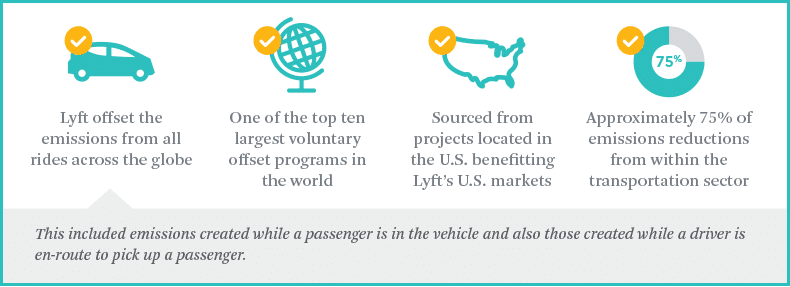
- In 2022, Lyft offset the emissions from all rides across the earth. This included emissions created while a passenger is in the vehicle and as well those created while a driver is en-road to pick up a passenger.
- Lyft's voluntary offset programme was one of the largest in the U.S. and among the top 10 in the world.
- All offset projects were located in the U.S. and have local social and environmental benefits in or near Lyft's U.Southward. markets.
- More than 75% of Lyft'southward initial investment funded emission reductions in the transportation sector from projects that are catalyzing change in the industry.
Project Spotlight
Carbon offsets lead to real change in automotive manufacturing process

The Meridian Magnesium project was the largest component of Lyft'due south initial portfolio. Located just outside of one of Lyft's major markets, Meridian manufactures magnesium-based automotive parts that reduce emissions during the manufacturing procedure and assist lightweight vehicles and improve vehicle fuel efficiency.
Lyft's back up helped emission reductions at Meridian'south Michigan manufacturing facility. This project required an upfront majuscule investment by Meridian every bit well as a modify in Meridian'due south manufacturing process that, while reducing greenhouse gas emissions, is more expensive and less efficient than the previous procedure. Carbon beginning sales are the only source of revenue for this project. Without it, Pinnacle would have no motivation to operate this project.
 Meridian was the first magnesium machine parts manufacturer to undertake this modify and helped constitute a new beginning methodology that could exist used past all magnesium role manufacturers. The project was only successfully re-validated by NSF International under the Verified Carbon Standard, affirming the scale and scope of the projection'due south existent and permanent climate bear on.
Now, based on Meridian's demonstrated ability to implement this change and fund it with gain from first sales, 3Degrees is discussing similar projects with two other magnesium producers that accept not nonetheless made the switch.
More than on 3Degrees Carbon Offsets

How To Set A Goal On Lyft,
Source: https://3degreesinc.com/resources/lyft-combats-climate-change-with-every-ride/
Posted by: perezmaing1993.blogspot.com
0 Response to "How To Set A Goal On Lyft"
Post a Comment