

How To Set Up Saltwater Aquarium
Setting Upwardly a Saltwater Aquarium
Developed with and approved past a qualified veterinarian.
Overview
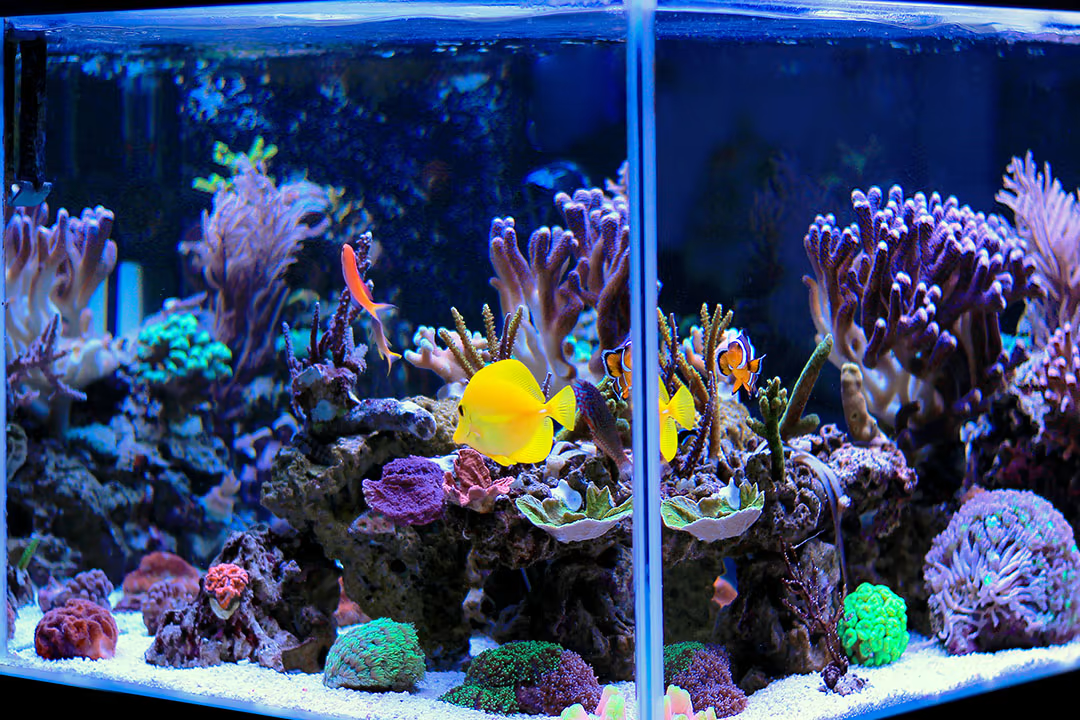
Bringing a piece of the body of water into your home is more doable than you might think. Marine aquariums commencement out as uncomplicated tanks of water, then aquatic life is added with the goal of creating the ultimate saltwater environment. A little extra intendance and patience in the kickoff will become a long way toward preventing headaches and creating a healthy and happy aquarium for years to come up.
Setting up your saltwater aquarium
Choosing a location
Before doing any work with the tank itself, determine the best location for your aquarium. It should be placed abroad from direct sunlight, windows, outside doors, rut vents and air conditioners. Rapid changes in h2o temperatures are extremely stressful for all aquatic life just especially so for saltwater fish.
Keep in mind that water weighs approximately 8 pounds per gallon, and so a 55-gallon tank will weigh over 440 pounds! Be certain your flooring will support this amount of weight. If you rent your home, check your lease; some apartments and condos limit the size of aquariums immune. As well, check for electric outlets. Most marine tanks will need access to at least four sockets. Allow enough distance between the wall and the back of the tank to fairly fit your filters and allow easy access for maintenance.
Setting up and preparing the tank
- Start by rinsing out the aquarium with warm water to get rid of any dust or debris inside
- Position the aquarium stand into place, making sure it is level. If you don't have access to a carpenter's level, place the aquarium on its stand up and make full with 1–2 inches of h2o. Check that the water is an even distance from the top of the stand on all four sides; an unbalanced aquarium tin be extremely hazardous. Placing an aquarium on an uneven or tilted surface increases the risk that the tank will tip over, crack or leak. A proper stand designed for an aquarium is important; using annihilation other than a manufactured tank stand may void your tank'southward warranty
- Make sure there is plenty space between the wall and the dorsum of the aquarium to fairly fit filters and cords and allow piece of cake access for maintenance
- If using an aquarium groundwork, affix the background to the tank before filling with water and placing the aquarium confronting the wall
- Fill the aquarium about a third of the way. Carefully dry off the bottom edge of the tank and stand, then bank check for leaks. Look for h2o beading upwardly on the bottom edge or running down the sides of the stand. If the aquarium leaks, empty it and return it to the store for a replacement. You can attempt to gear up it, but repairing a leaky tank is difficult, with no guarantee of success
Edifice your aquarium
- Filter and skimmer: Prepare your filter and poly peptide skimmer, if utilizing, co-ordinate to the manufacturer'south directions. Exercise non plug your filter or poly peptide skimmer in yet
- Add together substrate: Rinse substrate and décor before placing into the aquarium—a kitchen colander works well, but be sure to disinfect it before using it for nutrient preparation. If purchasing live sand, rinse it in a saucepan of premixed saltwater, then discard the dirty saltwater. Do not add live sand to the aquarium until after the salt has been added
- Fill the tank: If no leaks accept been noted, fill up the tank with water, leaving a couple of inches beneath the top to allow for water displacement if live stone and sand are being added. To protect the décor and aquascaping, as well as prevent splashing, identify a small-scale saucer or basin into the tank and pour the water directly onto that. Check the tank for leaks
- Water conditioner: Add the appropriate amount of water conditioner or additive to the tank
- Heater: Identify the heater into the tank. Do not plug it in at this fourth dimension. The best placement depends on the type of heater. Not-submersible clip-on heaters that must hang vertically in the tank should be placed as close to the outflow of the filter as possible. Submersible heaters should be placed as close equally possible to the intake of the filter. These placements allow the heated water to be better dispersed throughout the tank. Recheck the aquarium again for leaks
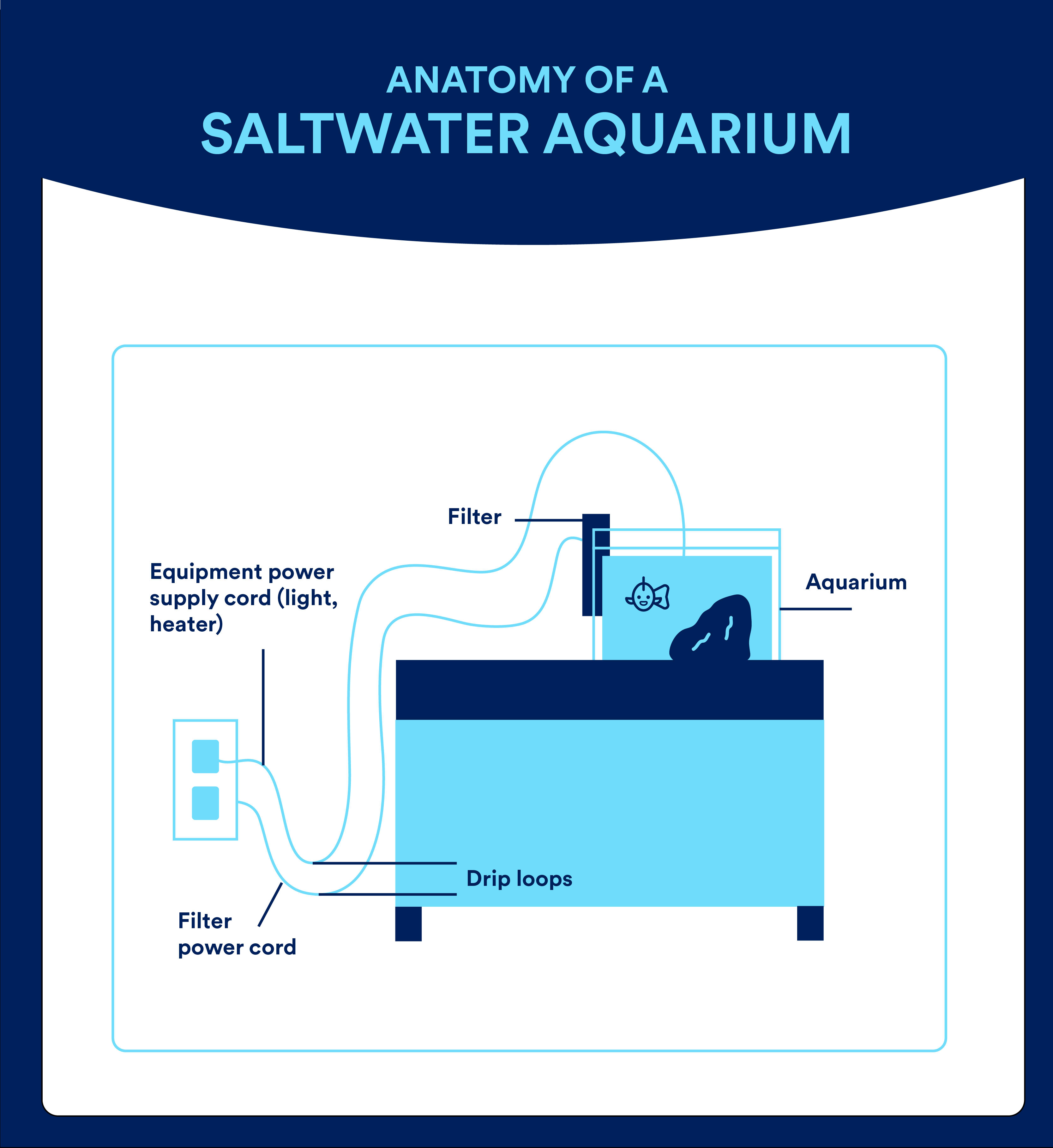
- Thermometer: Install the thermometer according to the manufacturer's directions. The thermometer should be on the contrary end of the tank from the heater in a position that is easy to cheque. Place the hood and light (if applicative) onto the tank. Plug in the filter and light. Make sure the cords running from the tank touch the footing earlier looping back up to the plug. This is called a "drip loop" and prevents h2o from running downward the cord into your electrical socket. Wait 20 minutes, then plug in your heater and protein skimmer. Elevation off your h2o level, if needed. Following the instructions included with the heater, adjust your heater to keep your tank between 74 and 80°F
- Common salt: Start adding commercial marine common salt, a little at a time, until you get a specific gravity reading of around 1.020 with the hydrometer or refractometer. Your goal is a specific gravity of ane.020 to i.025 for fish–simply aquariums and 1.023 to 1.025 for aquariums that business firm fish and invertebrates. It may accept up to 24 hours for the specific gravity level to stabilize, so wait before making your final specific gravity adjustments. After the specific gravity has reached 1.020, you can add together live sand and live rock, if desired. Add together more h2o to finish filling the aquarium, if needed
- Heater: Place the heater into the tank. Do not plug it in at this time. The best placement depends on the blazon of heater. Not-submersible clip-on heaters that must hang vertically in the tank should be placed equally shut to the outflow of the filter as possible. Submersible heaters should be placed as shut as possible to the intake of the filter. These placements permit the heated water to be amend dispersed throughout the tank. Recheck the aquarium over again for leaks
- Thermometer: Install the thermometer according to the manufacturer'southward directions. The thermometer should exist on the opposite cease of the tank from the heater in a position that is easy to check. Place the hood and light (if applicative) onto the tank. Plug in the filter and light. Brand sure the cords running from the tank touch the ground before looping support to the plug. This is called a "drip loop" and prevents water from running downwardly the cord into your electrical socket. Wait xx minutes, then plug in your heater and protein skimmer. Top off your water level, if needed. Following the instructions included with the heater, adjust your heater to keep your tank between 74 and 80°
- Table salt: Start adding commercial marine salt, a piffling at a time, until you become a specific gravity reading of effectually ane.020 with the hydrometer or refractometer. Your goal is a specific gravity of 1.020 to 1.025 for fish–only aquariums and 1.023 to one.025 for aquariums that house fish and invertebrates. It may take up to 24 hours for the specific gravity level to stabilize, so await before making your final specific gravity adjustments. After the specific gravity has reached 1.020, you can add live sand and live rock, if desired. Add more than water to finish filling the aquarium, if needed
Stabilizing period
Your marine aquarium is now set up and running, only don't rush off to buy aquatic life just all the same. You need to wait until the temperature and specific gravity accept remained stable for 24–48 hours. This allows the atmospheric gases in the h2o to dissipate and the salt to fully dissolve, and lets y'all ensure the heater is working correctly. Don't panic if your h2o becomes cloudy. Look until the cloudiness dissipates before adding aquatic life.
If the h2o temperature and specific gravity levels have remained stable for 24–48 hours and the cloudiness has disappeared, you lot are now ready to begin the cycling process of your new tank. Additives tin can assistance speed upwardly the nitrogen cycle. Refer to the Nitrogen Cycle Care Sheet for your next steps.
Ongoing maintenance and care
- Maintaining great water quality with regular h2o changes and adequate filtration is important to help keep your marine tank healthy.
- Daily: Bank check filter, h2o temperature and other equipment
- Weekly: Exam h2o quality at least once a week. If caring for corals and invertebrates, ensure alkalinity, calcium and magnesium levels are stable. Scrape algae growth as needed
- Weekly to monthly: Change 10–25% of the full book of water every 2–4 weeks, or as needed; alter filter media monthly
- Circumspection: Never utilise soap or chemicals on any elements of a fish tank. A mixture of water and vinegar 50/l works very well to clean the outside of the aquarium and whatsoever components needing a refresh. Lather and other chemicals can exist harmful to aquatic life
Supplies
- Aquarium
- Aquarium stand up
- Full-spectrum lighting
- Cover
- Heater
- Filter
- Poly peptide skimmer
- Marine aquarium table salt
- Refractometer
- Thermometer
- Water conditioner
- Marine substrate
- Live rock
- Décor
- Water test kit
Tank Wellness/Troubleshooting
| Health Result | Symptoms or Causes | Suggested Action |
|---|---|---|
| Issue Cloudy h2o | Causes Tank cycling (leaner bloom), substrate residue, organics and heavy minerals in tap h2o | Suggested Action Perform a ten–25% water change and siphon the substrate, removing residue droppings; water clarifier additives may help; reverse osmosis h2o filters can remove contaminates found in tap water; add together a nitrifying bacteria additive |
| Issue Green water | Causes Algae flower, too much light (straight sunlight), excessive nutrients, overfeeding, overstocked aquarium | Action Reduce photograph flow and cake whatsoever direct sunlight; increase water change frequency; reduce feeding; ultraviolet filtration tin can assist with destroying algae cells |
| Effect pH fluctuations | Causes Buildup of organic material and droppings, increased levels of CO2 | Activity Perform a ten–25% water change; reduce feeding; increment water circulation and surface agitation |
| Result Ammonia spike | Causes Bereft nitrifying bacteria, too many fish | Action Perform a 10–25% water alter and practise non siphon the substrate; reduce feeding; add together a nitrifying bacteria additive |
FAQs
- What supplies do you lot need for a saltwater aquarium? Some bones items you will need for a successful marine aquarium include an aquarium, stand up, light, cover, heater, filter, protein skimmer, marine aquarium salt, refractometer, thermometer, h2o conditioner, substrate and alive rock.
- How exercise y'all maintain a saltwater aquarium? Maintaining a marine aquarium will consist of regular tasks, such as daily checks to ensure equipment is functioning properly and topping off water evaporation, plus weekly water testing and h2o changes that are needed to keep your aquatic life happy and healthy.
Boosted care sheets
Notes and resources
Inquire a Pet Care Center store associate about Petco'due south option of products bachelor for the care and happiness of your new pet. All products carry a 100% money-back guarantee.
Because all aquatic life are potential carriers of infectious diseases such as atypical mycobacterium and salmonella, ever wash your easily before and after handling your aquatic life or habitat contents to help prevent the potential spread of disease.
Pregnant women, children under the age of 5, senior citizens and people with weakened immune systems should contact their physician before purchasing or caring for aquatic life and should consider not having aquatic life every bit a pet.
Go to cdc.gov/healthypets for more information about aquatic life and disease.
The data on this intendance sheet is not a substitute for veterinarian care. If you need additional information, delight contact your veterinary as appropriate.
Setting Up a Saltwater Aquarium
Source: https://www.petco.com/content/petco/PetcoStore/en_US/pet-services/resource-center/caresheets/setting-up-a-saltwater-aquarium.html
0 Response to "How To Set Up Saltwater Aquarium"
Post a Comment